
- Children under 18 months: no screens except video calls; 18-24 months: very limited co-viewed content; ages 2-5: about 1 hour daily; 6-10: 1-1.5 hours recreational; 11-14: about 2 hours recreational
- The kind of screen time matters more than the duration: passive (scrolling, autoplay) is most concerning; creative and connective (video calls, making things) is most beneficial
- Screen-free mornings, no screens at meals, and devices off at least one hour before bed have the biggest impact on sleep and behaviour
- Devices should charge outside the bedroom from about age 10 onward to protect sleep and reduce night-time use
- Heavy passive screen use in young children is linked to delayed language development, shorter attention spans, and disrupted sleep
- When reducing screen time, replace it with a competing activity rather than just removing the screen — boredom plus a board game works better than boredom alone
- Conversation about content and app design works better than control alone for children aged 8 and above
A calm, age-by-age guide to how much screen time is genuinely fine, what kind of screens matter more than minutes, and the small daily habits that make this whole thing easier.
Almost every parent I speak to brings up screens within the first ten minutes. Sometimes apologetically, sometimes defensively, almost always with a tired half-smile. The honest truth is that the rules our parents had, "no TV before homework", do not map onto a world where the homework is on the screen, the friend group lives on the screen, and the bedtime story is, occasionally, also on the screen.
So instead of another scary list, here is a slower look at what the research actually says, what kids of different ages need, and what you can do tonight that will help by the weekend.
How much screen time is actually okay?
The clearest, most consistent guidance from the World Health Organization and the American Academy of Pediatrics looks something like this:
| Age | Recommended limit | What counts |
|---|---|---|
| Under 18 months | None, except video calls | Video calls with family are fine |
| 18–24 months | Very limited, co-viewed | Only high-quality content, watched with a parent |
| 2–5 years | About 1 hour a day | Educational, slow-paced content |
| 6–10 years | 1–1.5 hours of recreational screens | Schoolwork screens are separate |
| 11–14 years | About 2 hours of recreational screens | Plus structured school and creative use |
These numbers are useful, but they are not the whole story. A child watching a documentary with you for ninety minutes is having a very different experience from a child scrolling short videos for ninety minutes. Neuroscientists who study this make a sharp distinction between three types of screen use, and that distinction matters more than the clock.
The three kinds of screen time
Passive Watching cartoons, scrolling reels, autoplay-driven content. The brain is largely a spectator. This is the kind to keep small and bounded.
Interactive Educational apps, age-appropriate games, drawing or music tools. The child is making decisions, sometimes solving problems. This earns more leniency, but it is still a screen.
Creative & Connective Video-calling grandparents, recording a story, editing a small film, learning a language together. This is the most valuable kind of screen time and often the kind we feel guiltiest about, oddly.
If you only change one thing this month, change the ratio. Aim for less of the first kind and more of the third.
What too much screen time actually does
The research here is more careful than the headlines suggest. The strongest evidence links heavy passive screen use in young children to delayed language development, shorter attention spans, disrupted sleep, and reduced time spent on the things that build a brain, conversation, free play, movement, boredom.
Notice the last word. Boredom is not the enemy. Boredom is where children invent. A child who has never been bored has never had to find their own next thought.
The goal is not zero screens. The goal is a childhood that is not crowded out by them.
A daily rhythm that actually holds
Strict daily limits tend to fall apart by Wednesday. What works better in most homes is a rhythm, predictable times when screens are on, and clearly marked times when they are not. Try this shape and adjust:
- Mornings are screen-free until everyone has eaten, dressed, and left the house or settled into the school day. This single rule changes mornings completely.
- One block in the afternoon or evening, time-boxed. Set a visible timer. Let your child see it count down, it removes you from the role of timekeeper.
- No screens during meals. Yours included. This is the hardest rule and the one your children will remember.
- Devices off at least an hour before bed. Blue light and dopamine-rich content both make it harder for young brains to wind down.
- Devices charge outside the bedroom from age ten onward, ideally in the kitchen or living room.
The conversations that matter more than the rules
By the time a child is eight or nine, control alone stops working. What replaces it is conversation. Talk about what they watched today. Ask what was funny, what was strange, what made them feel weird. You are not interrogating, you are showing them that screens are something we think about, not something we numb out with.
For older children, talk about how the apps are designed, the autoplay, the infinite scroll, the tiny dopamine pulses on every notification. Children who understand why something is engineered to be hard to put down are far more likely to choose to put it down.
If your child is already on screens too much
Don't go cold turkey. It rarely sticks, and it sets up screens as the forbidden treasure. Instead, shrink the window in stages. Cut thirty minutes a day this week. Replace it with something that competes, a board game in the cupboard, a cricket bat by the door, a half-finished puzzle on the table. The replacement is what makes the cut survive.
And let yourself off the hook for the lockdown years, the holiday week, the long flight. Childhood is a long average, not a daily score.
Quick answers parents ask us
Is two hours of screen time a day too much for a 7-year-old?
Two hours of recreational screen time for a school-age child is at the upper end of what most paediatric guidelines suggest, but it depends on what the two hours look like. Two hours of slow, educational content with breaks is very different from two hours of short-form scrolling. The kind matters more than the count.
Does educational screen time count toward the daily limit?
Most experts treat schoolwork screens separately from recreational ones. A child doing an hour of online maths plus an hour of cartoons is closer to the recreational limit, not over it.
What's the worst type of screen time for kids?
Fast-paced short-form video, played in long unbroken sessions, especially close to bedtime. It trains the brain to expect novelty every few seconds and disrupts sleep on top of it.
Should I take screens away as punishment?
Occasionally fine, but try not to make screens the main currency of your household. When everything else loses meaning compared to a device, the device has won.
My toddler watches cartoons while I cook dinner. Am I a bad parent?
No. You are a parent cooking dinner. Twenty minutes of a calm show while you make a meal is not what the research is worried about. It's worried about screens replacing speech, play, and sleep across the day.

 How STREAM-Based Toys Quietly Build Sharper, More Curious Thinkers
 Preparing Your Child for the First Day of School (Without the Drama)
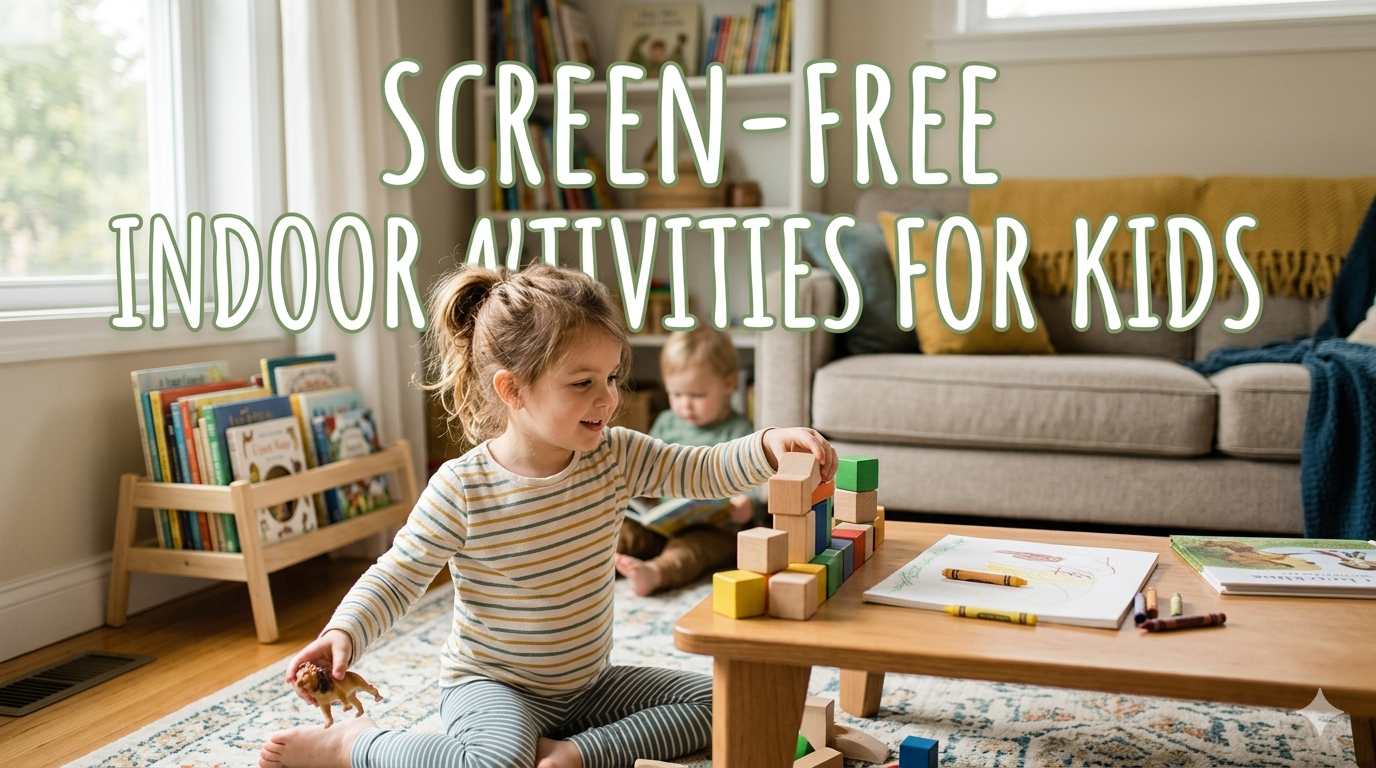 50 Screen-Free Indoor Activities for Kids (Tested by Real Parents)