
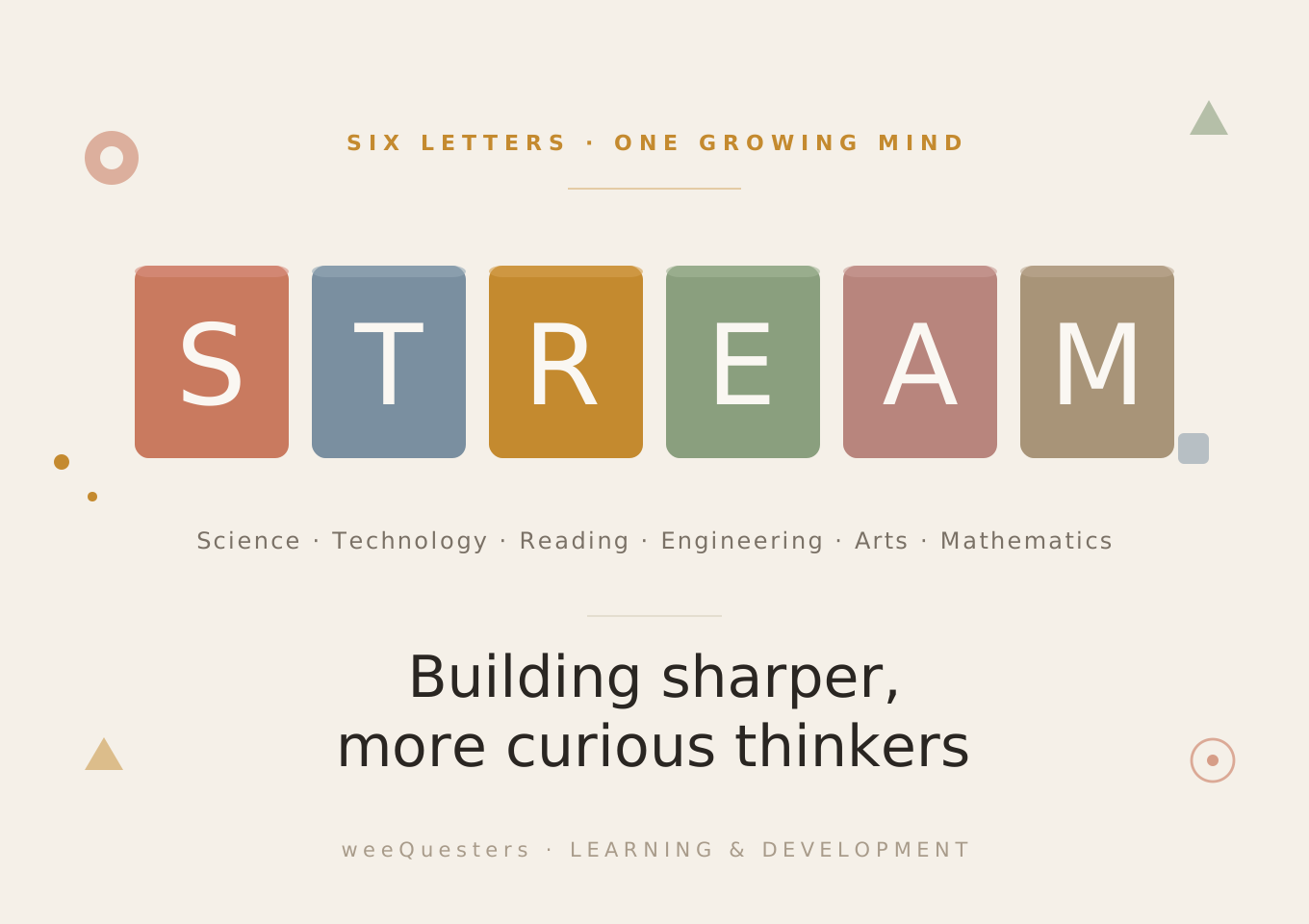
- STREAM stands for Science, Technology, Reading, Engineering, Arts, Mathematics — an evolution of STEM that adds Arts and Reading to reflect how cognition actually works across subjects
- The brain forms over a million neural connections per second between birth and age 8, with about 90% of brain growth complete by age 5, making early-years play uniquely high-leverage
- Cognitive ability is a cluster of skills — working memory, attention, problem-solving, spatial reasoning, language, and executive function — and STREAM toys engage several of them in a single play session
- Construction-style play is strongly linked to spatial reasoning, which is one of the best predictors of later mathematics and science achievement
- Open-ended toys with no single correct outcome consistently outperform prescriptive single-solution toys for language, problem-solving, and sustained engagement
- Four criteria for choosing well: more than one right answer, slightly above current ability, invites conversation, durable enough for repeated messy use
- A small rotated set of toys used consistently outperforms a large collection used occasionally — rotation refreshes cognitive engagement without new purchases
- Screen-free coding and STREAM toys are particularly valuable for under-sevens because tactile feedback supports cognitive load at that age
- A toy that asks the child to do the thinking is almost always better than one that does the thinking for them
STEM has expanded — and the new acronym is doing more than rebranding shelves. Chosen well, STREAM toys train the cognitive muscles children will lean on for decades, not weeks.
There's a particular kind of stillness that settles over a child mid-build. Tongue tucked into the corner of the mouth, eyes flicking between two pieces, hands turning a block to find the side that fits. It looks like quiet. It is, in fact, intense cognitive work — the kind of work that a thoughtful toy can either invite or interrupt.
This is the case for STREAM-based toys. Not as a buzzword, not as a marketing badge stuck on the front of a box, but as a small daily scaffolding for how children learn to think.
What STREAM actually stands for
STREAM is an evolution of STEM (Science, Technology, Engineering, Mathematics) and STEAM (which adds Arts). STREAM stretches the frame further to include Reading — recognising that literacy and language are part of the same cognitive ecosystem as numeracy and engineering, not a parallel track.
So the full unpacking is: Science, Technology, Reading, Engineering, Arts, Mathematics.
The point of the framework isn't to make every toy hit all six letters. It's to remind us that real cognition rarely lives inside a single subject. A child building a marble run is doing physics, geometry, planning, and problem-solving in the same breath. A child reading a story about a shipwreck is doing comprehension, sequencing, empathy, and spatial imagination at once. STREAM toys, at their best, simply make that overlap visible.
Why the early years carry so much weight
Between birth and roughly age eight, the brain forms more than a million new neural connections every second. By age five, around 90% of brain growth has already happened. The connections that get used get reinforced; the ones that don't get pruned away. This is why what children do in these years — what they touch, sort, build, narrate, and wonder about — matters more than at almost any other point in life.
Cognitive ability isn't one thing. It's a cluster: working memory, attention control, problem-solving, spatial reasoning, language, reasoning under uncertainty, and the executive functions that hold all of it together. STREAM toys are useful precisely because they engage several of these at once, in the messy, layered way children actually learn.
What each letter builds
S Science
Pouring water through a funnel, watching ice melt, sorting magnetic from non-magnetic objects, planting bean seeds in a transparent jar — all of it is the scientific method in disguise: observe, predict, test, revise. Toys like simple microscopes, magnetic exploration kits, weather stations, or a basic chemistry set for older children give children a gentle on-ramp to hypothesis-thinking.
What it builds: observation, prediction, cause-and-effect reasoning.
T Technology
Technology doesn't have to mean a screen. Coding caterpillars, button-based programmable robots, simple circuit kits, and gear-based mechanical toys all teach the central technological habit: giving precise instructions, then watching what happens. Screen-free coding toys are particularly useful for under-sevens, where tactile feedback still does most of the cognitive lifting.
What it builds: logical sequencing, debugging mindset, abstract thinking.
R Reading
Story cubes, picture-rich storybooks, alphabet puzzles, audiobooks paired with tactile props — reading-related toys quietly build vocabulary, narrative structure, and the working memory needed to hold a long thought. A child who can follow a four-step story can later follow a four-step instruction. It's the same muscle.
What it builds: vocabulary, comprehension, narrative reasoning, sustained focus.
E Engineering
Building blocks, magnetic tiles, marble runs, bridge-building kits, and open-ended construction sets train the most underrated cognitive skill of all: iterative design. Try, fail, adjust, try again. Engineering toys are where children first learn that "wrong" is just data — a lesson that pays out for the rest of their lives.
What it builds: spatial reasoning, planning, resilience, fine motor control.
A Arts
Open-ended art supplies, clay, weaving frames, simple instruments, dress-up kits — these are not the soft side of STREAM. Creative play is where children rehearse divergent thinking: the ability to generate many possible answers, not just one. It's the same muscle that, later, will let them write essays, design products, or solve novel problems no one has handed them an answer key for.
What it builds: divergent thinking, emotional regulation, symbolic representation.
M Mathematics
Pattern blocks, counting bears, balance scales, dice-based board games, tangrams. Mathematical thinking begins long before formal arithmetic — it begins with sorting, comparing, sequencing, and recognising patterns. Maths toys make these moves feel like games rather than drills, which is exactly the cognitive disguise you want at this age.
What it builds: number sense, pattern recognition, logical reasoning.
What the research actually shows
A few things worth holding in mind, separate from the marketing copy.
Children who engage regularly with construction-style play show measurably stronger spatial reasoning, which in turn predicts later achievement in mathematics and the sciences. Open-ended toys — the kind with no single "right" outcome — are consistently linked to richer language and more flexible problem-solving than highly prescriptive toys with one correct end state. Pretend play is associated with stronger executive function. And screen-free play, particularly in the under-fives, is repeatedly linked to better attention spans and richer parent-child language exchanges.
None of this means a single toy will transform a child's cognitive trajectory. It means the steady drip of the right kinds of play, over years, does.
How to choose well
A few questions worth asking before a toy comes home.
Does it have more than one right answer? Toys that can be used in only one way tend to be played with for a few hours and abandoned. Toys with a hundred possible configurations get played with for years.
Is it pitched slightly above where the child is now? The sweet spot is the just-stretching zone — challenging enough to require effort, not so hard that it produces only frustration.
Does it invite conversation? The cognitive value of a toy often lives in the talk around it — the "what do you think will happen if…", the "why did that fall over?". Toys that pull adults into the play are doing double work.
Is it durable enough to be used messily? Cognitive growth happens through repetition. Anything too fragile to be left out, dropped, or reassembled fifty times is doing less work than it could.
A simple weekly rhythm
You don't need a shelf full of new toys. You need a small, rotated set used consistently. Something like this works well across ages:
- A construction set always available — blocks, magnetic tiles, or LEGO depending on age.
- A reading basket refreshed weekly, mixing fiction, non-fiction, and wordless picture books.
- One open-ended art material on the table at all times — paper and crayons count.
- A maths or pattern game that comes out two or three evenings a week.
- A science micro-experiment once a weekend — kitchen-based is perfectly fine.
- A coding or logic toy in regular rotation for older children.
Rotation matters more than abundance. Toys that disappear for a few weeks and come back feel new again, and the cognitive engagement returns with them.
What STREAM toys do for cognitive ability
- Engage multiple cognitive systems — memory, attention, reasoning, language — in a single play session.
- Train iterative thinking: hypothesis, test, adjust, repeat.
- Strengthen spatial reasoning, the strongest predictor of later STEM achievement.
- Build divergent thinking through open-ended materials with no single right answer.
- Develop executive function — the brain's command centre — through pretend and construction play.
- Reinforce the "wrong is just data" mindset that underpins resilience.
A note on screens
STREAM-branded apps and tablets are everywhere now. Some are genuinely useful. Many are not. The rule of thumb worth remembering: a toy that asks the child to do the thinking is almost always better than one that does the thinking for them. A blank notebook out-thinks most educational apps. A handful of blocks out-thinks most coding games for the under-sixes.
Screens have a place — used deliberately, with company, and with conversation. They aren't a replacement for the slow, hands-on, body-engaged work that builds the cognitive substrate underneath everything else.
What it looks like, in the end
A child who has grown up with thoughtful STREAM-style play tends to be recognisable not by what they know but by how they approach what they don't know. They ask why. They try things. They tolerate not getting it right the first time. They notice patterns. They tell stories about what they've built.

 Preparing Your Child for the First Day of School (Without the Drama)
 50 Screen-Free Indoor Activities for Kids (Tested by Real Parents)
 Raising a Confident Child Without Raising a Loud One